

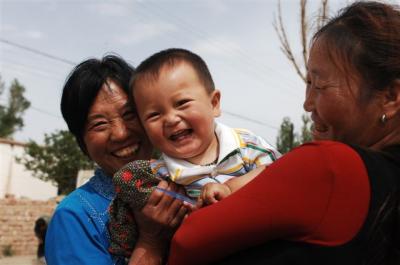
Sourire chinois. Photo Thomas BREGARDIS
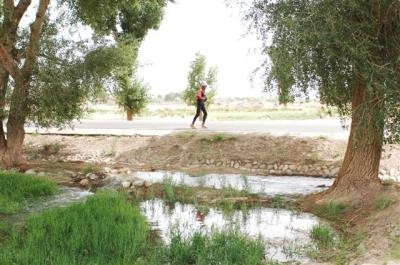
Près d’une riziere. Photo Thomas BREGARDIS
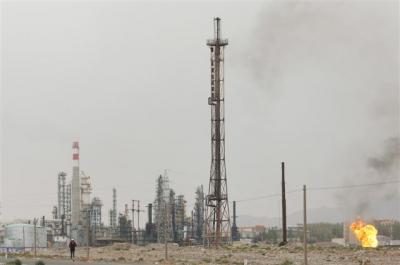
ville petrolifère de YUMEN. Photo Thomas BREGARDIS
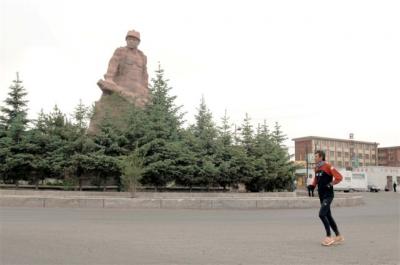
Devant une statue du "Travailleur exemplaire" Photo Thomas BREGARDIS
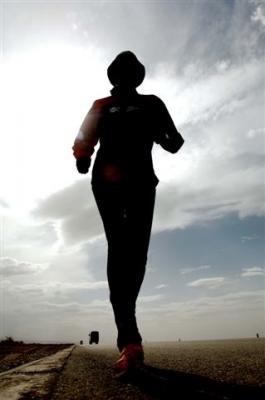
Sous le soleil. Photo Thomas BREGARDIS
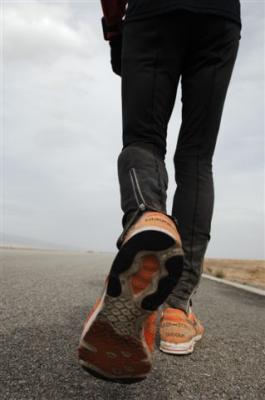
Que de bitume foulé! Photo Thomas BREGARDIS
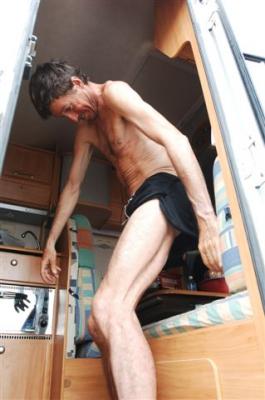
Les courbatures du soir. Photo Thomas BREGARDIS
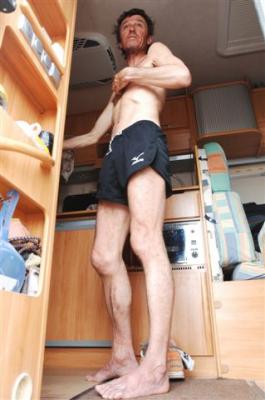
Direction la douche. Photo Thomas BREGARDIS
D166 – 74.7Km
THURSDAY, JUNE 1
N40 05.784 E97 19.240 (1586m) – N39 49.057 E97 56.414 (1842m – Yumen Dong Zhan)
74.7 km – 10H57′
Serge apprehends the first four hours, which, for the past few days, he has found to be very long, even though he admits that he doesn’t have second thoughts about leaving in the morning. “It has become a habit” he said. The first hours give an idea of how long the day will be and Serge starts slowly. He knows that he will have to pass 11H00, minimum, to reach the mileage that he has set himself. That is what is the toughest for his morale.
At kilometer 40, we went through the city of Yumen, at an altitude of 2200 meters. In 1938 this became the first oil field in China. Today, the production of its 5 wells is 3 million tons and the refinery of the city, which we passed holding our noses, is linked by an 800 kilometer pipeline to Lanzhou, the capital of the province.
This oil producing city is very sad and we left it without regret. Our camp will be just as sad, with a view of several factories and in the distance the works for the toll road, with their long trail of dust, which we now know so well.
Here are a few questions from Cyril, one of our faithful readers and Serge’s response:
What do you think of your feat? Are you pleasantly surprised by what you are achieving or do you find it normal? Do you keep surprising yourself or do you know yourself so well there are no surprises? Do you keep pushing forward your goals?”
“This race has been one of discovery for me because I had a lot of unknowns to manage in connection with the route, which was unfamiliar to me, and with the number of kilometers.
Up to now, the route has been varied, with passages in the mountains, along the Adriatic and Black Seas, in the countryside and in large cities such as Istambul and Tehran. There have also been extreme temperatures because we have experienced between -15° Celsius 53° Celsius. We didn’t have any spring to speak of.
The number of kilometers is important. Naturally, I add up the 1,000 kilometers; however, most important are the intermediate objectives that I set in order to keep going. Before China my objective was to cross the Chinese border before April 28 and I didn’t think of anything else. As soon as I had crossed that border, I began thinking about Tokyo. There I was wrong because I started getting carried away. I have forced myself not to look so far ahead so my next objective is Lanzhou, and so forth, stage by stage, little by little, in order to keep my motivation intact.
Surprise: Yes, I surprised myself because I though that 70 kilometers per day was setting the bar a bit high; however, for the moment I’m doing better than that. But after my two falls, and with the danger on the roads and with the trucks, I realize that the race could stop at any time if I were to break something. So I’m as careful as I can be, even when I’m fatigued. I could also encounter bad weather and be delayed. Until the last kilometer is run there is no victory and that’s why I have to keep my head on my shoulders and not get carried away. Humility is the name of this game.
As for normality, I don’t have the answer. On my road I’m the happiest of men. Is it normal to be happy? In any case, I have found happiness.
I don’t know what my ultimate limits are. Maybe I will have the answer by the time I reach Tokyo.”