

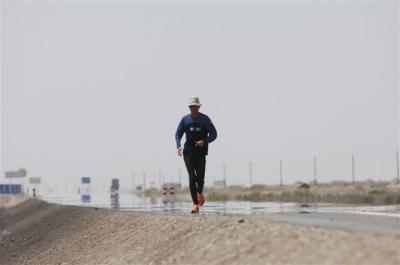
Retour de la chaleur… Photo Thomas BREGARDIS
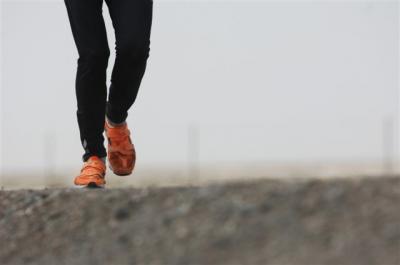
Plus de 10.000km à pied, sa use, sa use…. Photo Thomas BREGARDIS
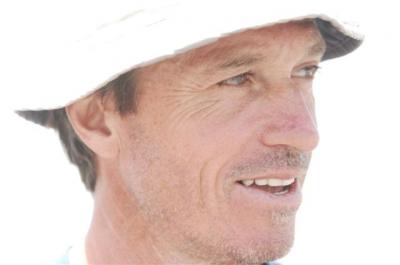
Serge en debut d’apres midi. Photo Thomas BREGARDIS
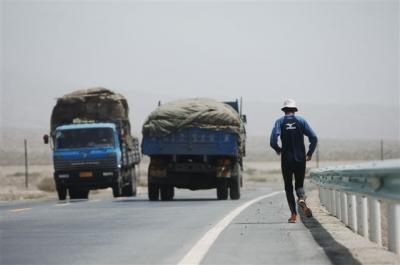
Poids mouche, parmi les poids lourds. Photo Thomas BREGARDIS
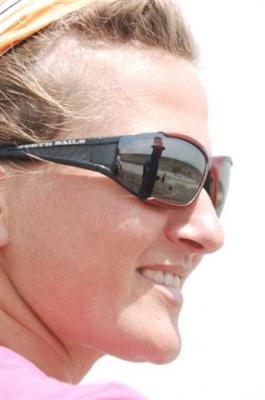
reflet aimant…. Photo Thomas BREGARDIS
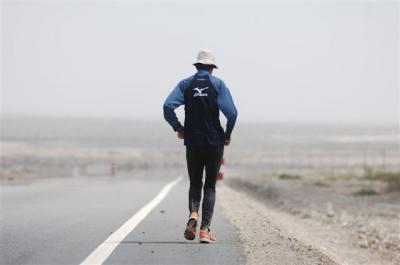
c’est dur! Photo Thomas BREGARDIS
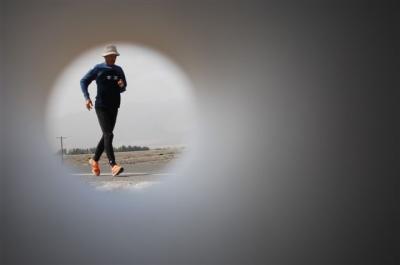
clin d’oeil Photo Thomas BREGARDIS
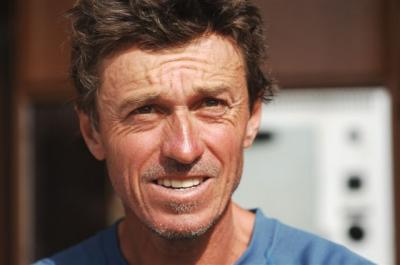
Serge en fin d’etape. Photo Thomas BREGARDIS
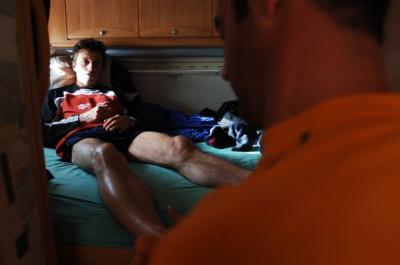
Massage réparateur. Photo Thomas BREGARDIS
D146 – 76.3Km
FRIDAY, MAY 12
N41 58.098 E84 45.426 (959m) – N41 53.398 E85 37.211 (943m)
76.3 km – 10H23′
JOINT AND MUSCLE PAIN:
Unbelievable as it may seem, Serge has no pain in his articulations. X-rays taken regularly over time indicate that Serge shows no signs of arthritis and that he has an exceptional bone density (in spite of the internal rotation of the femur and the external rotation of the tibia on the right side, his knee is not adversely affected and after much discussion we have decided not to correct the right foot, which turns to one side, even if Serge finds it rather inelegant, it gives him his balance).
Some may not agree, but it’s my personal opinion that it’s his nature, and many of us, even those younger than he, could envy his bone structure. The only pain that recurs is in his back and is located at the dorsal-lumber junction. X-rays show a straightness of the entire spine, which indicates great stiffness, and it’s true, Serge is far from being a model for litheness.
There is pain in the muscles, tendons, ligaments: all the soft tissues are heavily solicited and that is what begins to worry me. In 1997, I felt that Serge was running without danger of hurting himself but today I’m a bit skeptical. I think that he hasn’t come away unscathed from the various crossings: athletic pubalgia (sports hernia/groin pain) in South America (black spots are still present on a scan), a right ankle sprain in Africa, which wasn’t properly treated and which now makes his ankle unstable and causes pain. There are other minor, recurring pains of the kneecap tendons, of the ischial bones, and aponeurosis of the right calf (linked to anterior compartmental syndrome, which was operated on in 1994).
Has Serge become used to all these pains? Yes, he lives with them. On this crossing he says that his legs are fine because even this morning he was trotting along during the first 100 meters.
Treatment against pain: Serge avoids using AINS (non steroid anti-inflammatory), which give him stomach problems (in South America he took an 8-day treatment which gave him strong stomach pains, then later he had a 15-day treatment with suppositories of anti-inflammatory drugs. Again, due to the same athletic pubalgia he had a one month treatment of Vioxx, which has since been withdrawn from the market). The races have been rough on Serge’s stomach and he decided not to take any AINS medicine on this crossing. Up to now he has periodically taken: paracétamol (Tylenol) and aspirin, especially between 8000 and 9000 kilometers. On the other crossings, Serge applied Flector Tissu Gel (we don’t believe there is any benefit in using anti-inflammatory creams). On this crossing, I haven’t brought any cream, gel or AINS for the Trans-Eurasia.
Serge has had two 15-day treatments of effervescent of multivitamins pills. More and more regularly (twice a week) he takes a Smecta and a Mopral. We have noticed that his gastric problems seem to be linked to intestinal problems (he takes doses of carbo-levure). He takes Fructoline (Chicory root, which helps regulate the intestinal environment and since Kirghistan he has been taking Spiruline, made by Flamand Vert).
In conclusion, Serge knows his body and his aches and pains well and he works to control them. However, each new pain is always a source of stress. Once it becomes familiar, pain is easier to handle, even if fatigue, stress or anxiety make it more difficult.
According to Serge, only those who have gone through this can understand that it isn’t masochism. Mental well-being, will power, and satisfaction from an objective which has been reached, enable the mind to transcend physical pain. But here, I think we are getting into a different subject!